How to Tell When a Shopify Discount Code Has Leaked

Pixoo
Multi-currency discounts for Shopify
How to Tell When a Shopify Discount Code Has Leaked
Key takeaways
- A leaked code sends no signal of its own. Shopify has no alert for it, and the usual first clue is a margin that came in lower than planned
- Two patterns give it away early: a sudden change of pace, and geographic spread a private code should never have
- Both need a floor you choose, because a small campaign doubling from 2 uses to 4 is noise, not a leak
- The right response is to tell you, not to switch anything off. An automatic shutdown turns a suspicion into refused orders from real customers
In this guide:
- How a Code Actually Leaks
- Why Shopify Will Not Tell You
- Signal One: The Pace Changes
- Signal Two: The Map Changes
- Why Alerting Beats Blocking
- Setting Thresholds You Will Not Regret
- FAQ
A leaked discount code never tells you it has leaked. There is no notification, no line in a report, nothing that changes colour. The code keeps working exactly as designed, which is the whole problem: it was built to be honoured, and it is being honoured.
What you notice, if you notice at all, is second-hand. A campaign that cost more than it was supposed to. A staff code redeemed by people who have never worked for you. A customer service reply asking why the code from a deal forum "does not work any more", from someone who was never sent it. By then the money is gone and the interesting question, which is when it started, is buried in an order export.
Searches like shopify discount code abuse and stop people sharing discount codes are almost always someone who has just had that conversation.
How a Code Actually Leaks
It is rarely dramatic. The common routes are mundane:
- A staff or friends-and-family code gets shared once, then again, and lands on a deal aggregator that scrapes and republishes it
- An influencer code is posted publicly rather than to the intended audience, which is sometimes the point and sometimes a mistake
- A single-use code from an email is forwarded, and the recipient posts it because it still worked for them
- A browser extension collects codes from checkouts it sees and offers them to every other user
None of those require bad intent from anyone in particular. A code is a string. Strings travel. That is true whatever the discount does underneath, whether it is a flat amount or a per-currency one.
The reason this matters more than it used to is that a code now spreads faster than a campaign runs. A promotion planned for a weekend can be public within hours, which means the damage is not proportional to how long you leave it live. It is proportional to how long it takes you to notice.
Why Shopify Will Not Tell You
Being fair to the platform: Shopify tracks usage carefully. You can put a total usage limit on a code, cap it to one use per customer, and see how many times it was redeemed.
What it does not have is a notion of normal. A usage limit is a hard stop, not a signal. It cannot tell you that a code doing 4 uses a day suddenly did 60, because it has no opinion about 4 being that code's usual pace. It will simply keep honouring redemptions until the limit is hit, and then stop honouring them for everybody at once, which is its own problem.
So the two things you actually want, an early warning and a sense of what is out of character, are not there. That gap is where leak detection lives.
Signal One: The Pace Changes
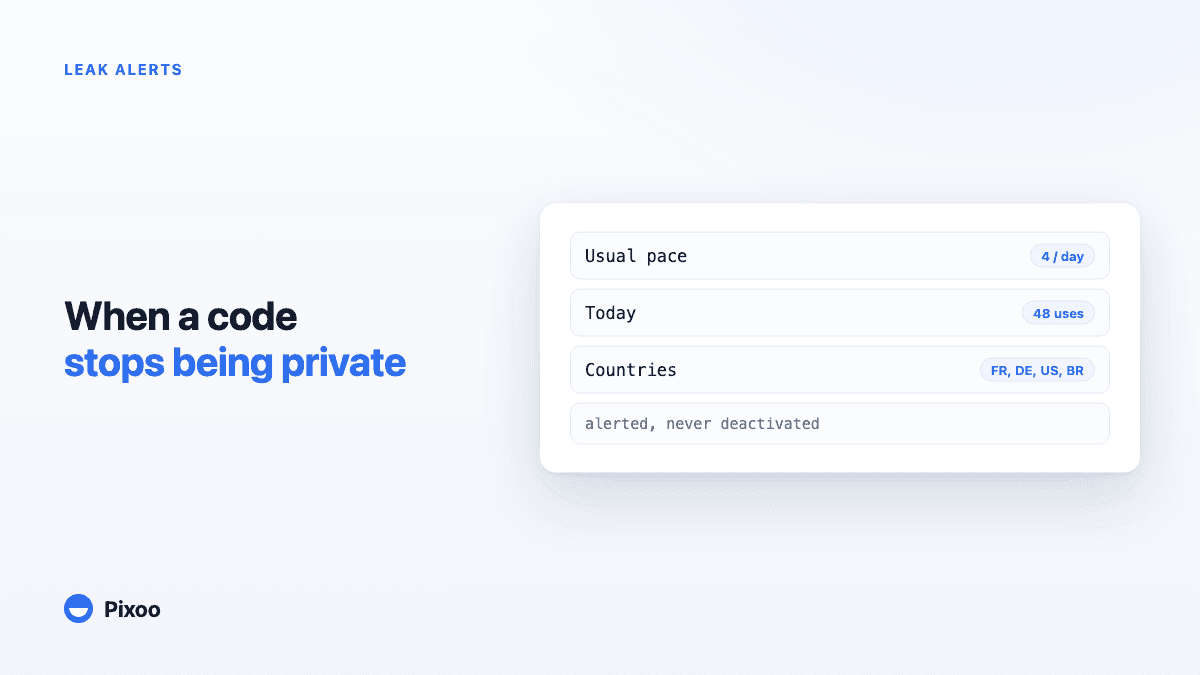
The first and strongest signal is rhythm. A code that has been redeemed a handful of times a day for two weeks, and then does ten times that in an afternoon, has almost certainly stopped being private.
The mechanic worth using is a multiple of the code's own history, not a fixed number. "Alert me when a discount does 3 times its usual daily uses" adapts to each campaign, where "alert me at 50 uses" is meaningless for a code that normally does 200 and useless for one that normally does 2.
But a multiple on its own produces noise, because early numbers are small. A code that went from 2 uses to 6 has technically tripled. That is why the multiple needs a floor you set: a minimum number of uses in 24 hours before the rule is allowed to fire at all. Below the floor, nothing happens, however dramatic the ratio looks.
There is a case where the multiple cannot help: a brand-new code, with less than a day of history. An average over no history is not an average. There, the floor alone decides, and the alert says so in plain words rather than quoting a comparison that does not exist.
Signal Two: The Map Changes
The second signal is geography, and for international stores it is often the sharper one.
A code sent to your French newsletter should be redeemed in France. If it starts converting in six countries in a single day, something happened to it that you did not plan. This works precisely because it does not depend on volume: a leak caught by geography can be five redemptions, not five hundred, and still be unambiguous.
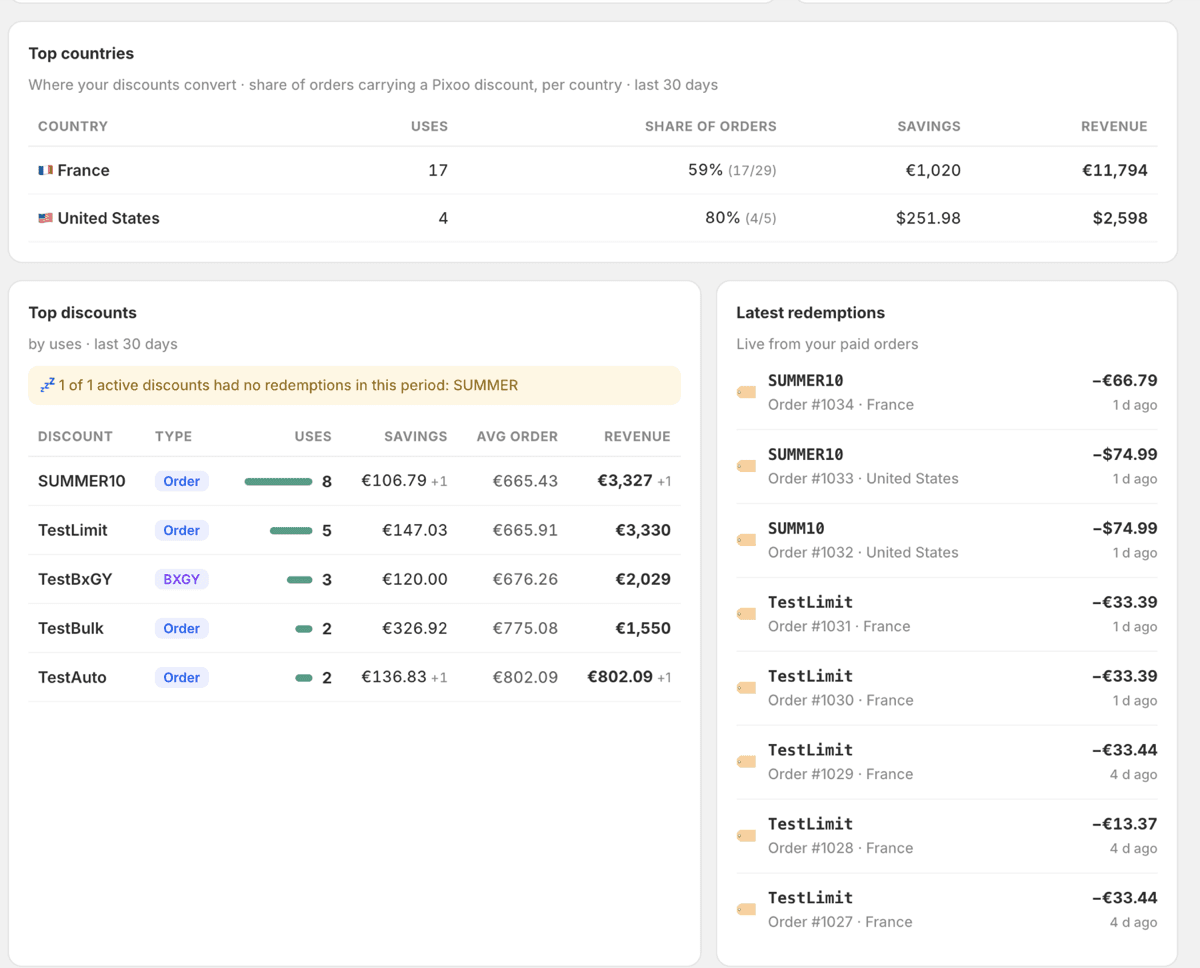
The threshold is again yours to set, because what counts as suspicious depends entirely on how you sell. This is also why reporting per currency and per country matters: you cannot judge a code's spread from a single blended total. A brand shipping to the EU with a single eurozone campaign might set it at 3 countries. A store selling worldwide with one global code would set it much higher, or leave the rule off and rely on pace alone.
Why Alerting Beats Blocking
The tempting design is automatic: detect the anomaly, deactivate the discount, stop the bleeding. We deliberately did not build that, and the reasoning is worth stating because it is not obvious.
A detection is a suspicion, not a fact. Every signal described above has innocent explanations. A pace spike is exactly what a successful post looks like. Geographic spread is exactly what happens when your product is featured somewhere international. Both patterns are indistinguishable, in the data, from the campaign going well.
So an automatic shutdown does not fail gracefully. It fails at the worst possible moment: the moment your promotion is working. Customers who did nothing wrong reach checkout, the code is refused, and they leave. You have converted a possible leak into certain lost orders, and you find out from complaints.
An alert has the opposite failure mode. If it is wrong, you read an email and ignore it. If it is right, you decide what to do with full context: deactivate the code, swap it, cap what it can spend, or accept it. The judgement stays with the person who knows whether that traffic spike was a leak or a lucky day.
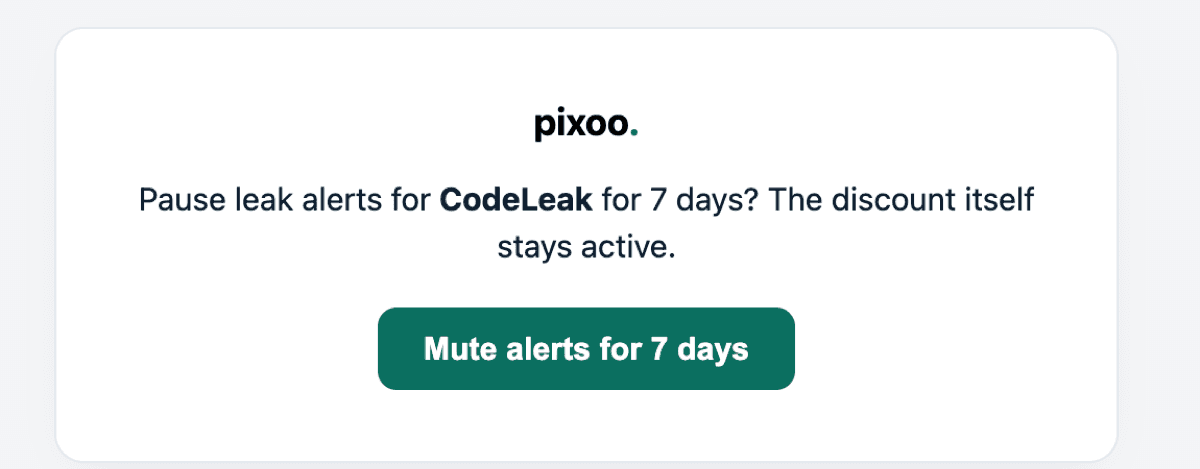
Even the mute link says it out loud: pausing the alerts leaves the discount running.
There is a second reason, quieter but real. A tool that switches things off on your behalf is a tool you have to supervise. One that only tells you things is one you can leave on and forget, which is the only way an anti-abuse feature survives longer than a month.
Setting Thresholds You Will Not Regret
Four habits keep the alerts useful rather than a source of noise you eventually mute.
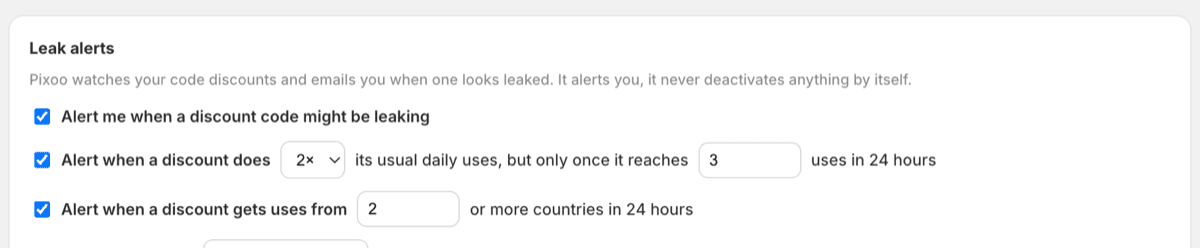
Start loose. A multiplier of 3 and a floor set slightly above your busiest normal day will fire rarely and mean something when it does. Tightening later is easy; recovering trust in an alert that cried wolf is not.
Set the floor from your own data, not from instinct. Look at what a good day actually is for that kind of campaign. If your codes typically do 5 to 10 redemptions a day, a floor of 20 means you only hear about genuine outliers.
Treat the two rules as answering different questions. Pace catches volume abuse, geography catches audience abuse. A code can leak in one dimension and look perfectly normal in the other, which is why they fire independently and you can run either alone.
Decide in advance what you will do. The alert buys you time, and time is only worth something if you have a plan. For most merchants the answer is a bulk batch of single-use codes instead of one shared code, because a leaked single-use code costs exactly one order rather than opening the offer to everyone who finds it.
That last point is the real fix. Detection tells you a shared code has escaped. Unique codes mean escaping is not worth much.
Frequently Asked Questions
How do I know if my Shopify discount code has been leaked?
The two reliable early signals are a sudden change in redemption pace, meaning a code doing several times its usual daily uses, and geographic spread, meaning a code intended for one market converting in several. Shopify does not surface either, because a usage limit is a hard stop rather than a signal, and the platform has no notion of what is normal for a given code.
Can I stop people from sharing my discount codes?
Not entirely, since a code is just a string and strings travel. What you can do is make sharing pointless: issue one single-use code per customer instead of one shared code, so a leaked code costs a single order. Detection then covers the shared codes you still need, such as influencer or seasonal ones.
Should a discount code be deactivated automatically when it looks leaked?
We do not think so. A pace spike and a geographic spread look identical, in the data, to a campaign going unusually well. Deactivating automatically means refusing real customers at the exact moment your promotion is working, and learning about it from complaints. An alert leaves the judgement with the person who knows the context.
What is a good threshold for a leak alert?
Set the multiplier around 3 times the code's usual daily pace, and the floor slightly above your busiest normal day for that kind of campaign, so ordinary success stays quiet. For the geographic rule, base the country count on how you actually sell: a eurozone campaign might use 3, a worldwide code much higher.
Will I get alerted repeatedly about the same code?
No. Alerts are limited to one per discount per rule per day, so a code that keeps being used does not fill your inbox. You can also mute a specific discount for seven days from the alert itself, which is the right move when a spike is expected traffic rather than a leak.
Do leak alerts work on automatic discounts?
No, and deliberately so. Automatic discounts apply from the cart contents rather than from a code someone can share, so there is no string to leak. The rules only watch code discounts, which is where the risk lives.
A leaked code is not really a security problem, it is a timing problem. The mechanics of a code being shared are not preventable, and the money involved is rarely enormous on any single order. What makes it expensive is finding out in the monthly numbers instead of the same afternoon. Everything above is about moving that discovery forward by a few weeks.
Recommended Articles
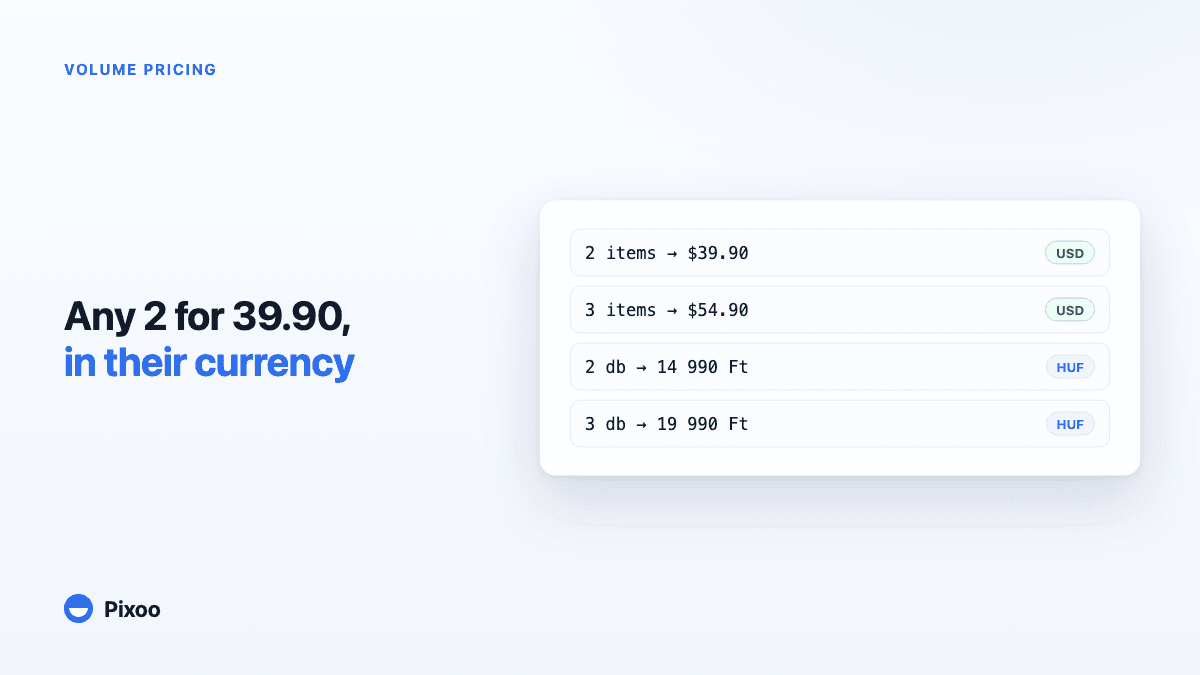
Shopify Volume Pricing in Every Currency: 2 for $39.90, 3 for $54.90, Without Converted Cents
A "2 for 30" offer only works if the price is round in every currency the shopper pays in. Here is why native Shopify discounts make that hard, and how Pixoo lets you type the price of the set per currency and works out the discount at checkout.
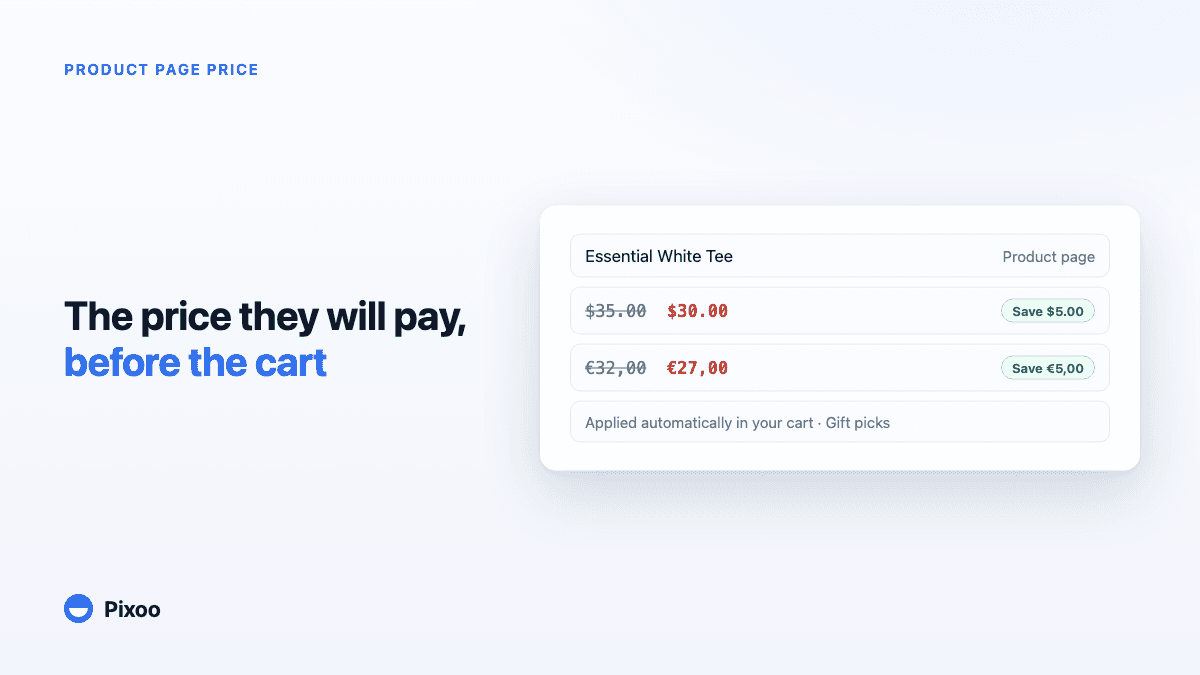
How to Show the Discounted Price on Shopify Product Pages, in Every Currency
An automatic discount on Shopify is applied in the cart, so the product page keeps showing the full price and most shoppers never learn there was a deal. Here is how to show the price they will actually pay, on the product page, in their own currency, without ever displaying a price the checkout will not honour.