Shopify Just Launched Market-Specific Discounts. Here's What It Does, and What's Still Missing.

Pixoo
Multi-currency discounts for Shopify
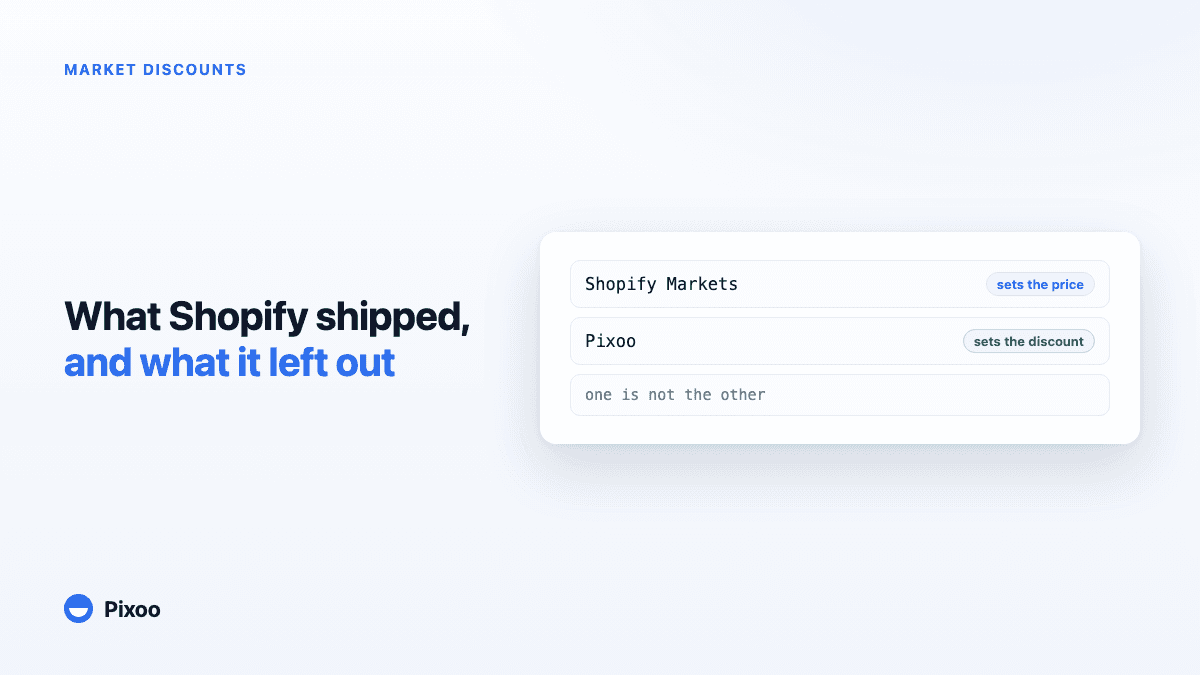
On May 7, 2026, Shopify rolled out one of the most requested merchant features of the last few years: the ability to assign discounts to specific markets. A day later, the developer changelog confirmed the same capability is now exposed through the Admin GraphQL API via a new markets field in DiscountContextInput.
This is good news. For years, merchants running international stores had to pick between blunt global discounts or fragile workarounds involving tags, scripts, or duplicate stores. Shopify's native solution closes a real gap, and it's great to see it land.
That said, if you've been running a serious cross-border operation, you already know that Shopify market-specific discounts and Shopify multi-currency discounts are not the same thing. The new release solves the first. The second is still wide open.
Let's walk through what shipped, where it works well, and the gaps that, for now, only a dedicated app like Pixoo can fill.
What Shopify actually shipped
The release lands in two parts: an admin-facing feature for merchants, and an API surface for developers and partner apps.
For merchants
On the Discount Details page, there's now an eligibility selector that lets you assign any code-based or automatic discount to one or more markets. The discounts list also gets new filters by market, customer segment, or specific customers, so you can quickly see what's active where. And the Market Details page now shows every discount tied to that market at a glance, with a "View-As" preview mode in the Markets graph view.
The use cases Shopify highlights are exactly the ones merchants have been asking for:
- Running an online-only flash sale without it triggering at retail locations
- Creating a wholesale offer that only reaches B2B buyers
- Building regional campaigns without duct-taping customer segments together
Discounts by Market is available for all merchants on Basic plans and above, provided they're on the new version of Markets.
For developers
The API side is just as interesting. Shopify introduced markets as a new option in DiscountContextInput, meaning you can target discounts to regional markets, retail locations, or B2B company locations programmatically. It works alongside the existing eligibility options (all, customerSegments, customers).
You can:
- Assign market eligibility to a discount when creating or updating it
- Query the
discountsanddiscountsCountfields on aMarketto list every discount tied to it - Filter discounts using
context:marketormarket_idsindiscountNodes
It's a clean implementation. If you're on API version 2026-07 or later, you'll see it. Older versions filter these discounts out entirely.
Why this matters, and why it took so long
Markets is Shopify's strategic answer to international commerce, and discounts were one of the last big pieces still tethered to a single, global eligibility model. Every merchant running multiple regions has the same story. A 20% off code meant for the UK launch quietly eats margin in Germany, France, and Australia. Or a flash sale on the online store accidentally fires at the till.
Native, first-party market targeting fixes that whole category of mistakes. It's foundational infrastructure, and it makes Shopify Markets meaningfully more useful for stores operating across countries, sales channels, or B2B/D2C segmentation.
So credit where it's due. Shopify shipped real infrastructure here.
But (and this is the part international merchants need to read carefully) targeting a market is not the same as targeting a currency. In cross-border commerce, the difference is where the money is actually made or lost.
The gap: market is not currency
Here's a scenario that exposes the limitation right away.
Imagine you sell in the EU as a single Shopify Market. Your customers in France pay in EUR. Some customers in Switzerland (depending on how you've structured your markets) may pay in CHF. Your B2B buyers in the same region might transact in USD because that's how the parent contract is denominated. Same market. Three currencies. Completely different price psychology, different conversion rates, different competitive landscapes.
Shopify's new feature lets you say "20% off in Europe". It does not let you say:
- "20€ off in EUR, 25 CHF off in CHF, 22 USD off in USD"
- "Free shipping above 50€, above 60 CHF, above 55 USD"
- "Buy 2 get 1 free, but only for customers paying in JPY"
Why does this matter? Because Shopify's automatic currency conversion is great for displaying prices, but it converts your discount values the same way. A "10 USD off" discount becomes a weird, decimals-everywhere figure in every other currency. £7.83 off. €9.14 off. ¥1,547 off. That's not a campaign. That's a math problem your customer has to do at checkout.
Merchants who care about conversion rates know this intimately. 76% of shoppers prefer to buy in their local currency, and they expect prices and promotions to feel native to that currency, not converted from one.
That's the gap Pixoo was built for, and it's still wide open in Shopify's native release.
The other limitations of Shopify's native release
Currency is the big one, but it's not the only gap. If you're evaluating whether the new feature covers your use case, here are the other constraints worth knowing about.
Eligibility types are mutually exclusive
Buried in the developer changelog: "eligibility types are mutually exclusive, you can target either markets OR customer segments, but not both simultaneously."
That single sentence rules out a lot of common campaigns. You can't natively run "20% off for VIP customers in France only". You can't run "free shipping for first-time buyers in the US". You have to pick one axis. For merchants who've spent years building customer segments and now want to layer geography on top, that's a real ceiling.
No bulk creation, no import/export
The Shopify admin still creates discounts one at a time. If you're launching a campaign that needs 5,000 unique promo codes (affiliate codes, influencer codes, retention codes), you're either clicking forever or writing a script against the API.
Pixoo handles bulk import/export of up to 100,000 entries, tested at that scale, with the same Shopify-native interface your team already knows.
Discounts don't inherit across market types
From Shopify's own docs: discounts assigned to a regional market won't apply to B2B or retail markets. They inherit within a market type (parent to child), but not across them.
In practice, that means a "spring sale" you want to run everywhere (online and B2B) has to be created and maintained three times. Three places to update. Three places to deactivate. Three places where something can quietly desync.
Requires the new Markets version
Discounts by Market is only available to merchants on the new version of Markets. If you haven't migrated yet, you don't get it. And API consumers on versions prior to 2026-07 will see these discounts filtered out entirely, which is a quiet breaking change for anyone with older integrations.
How Pixoo extends what Shopify just shipped
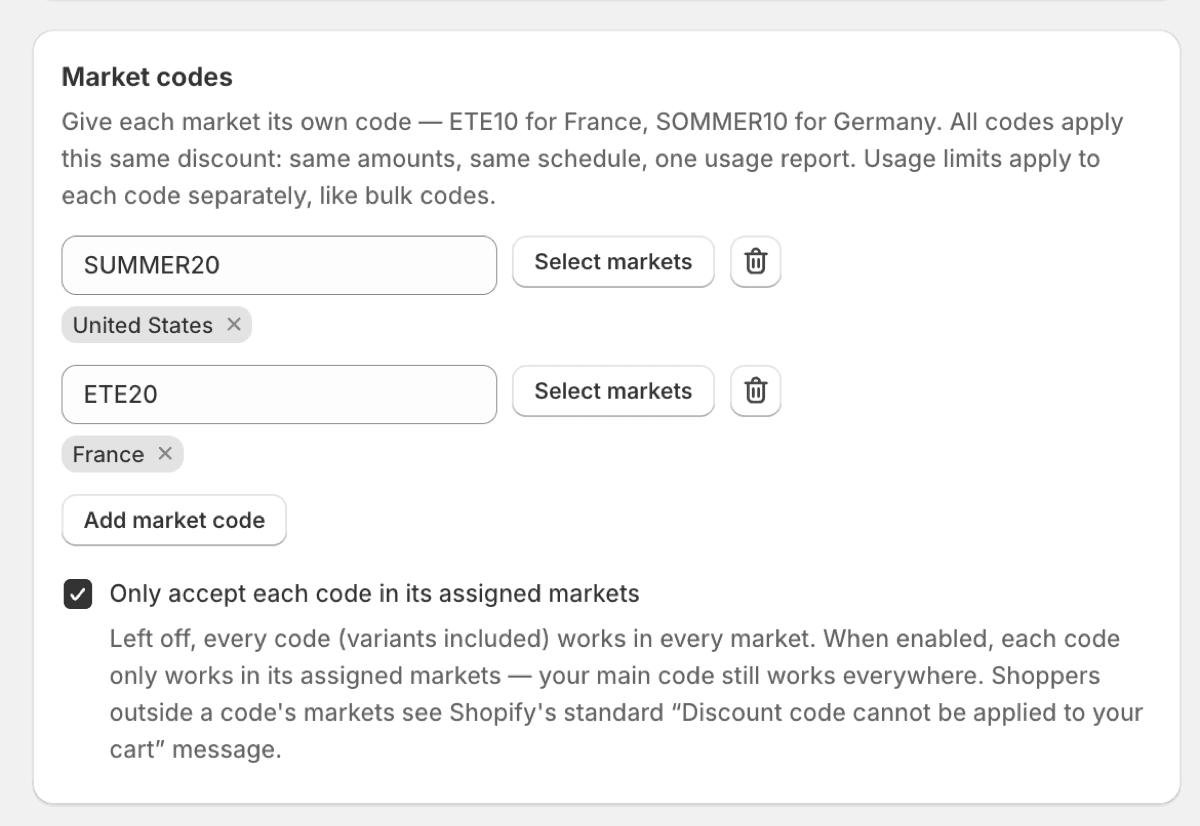
Pixoo has always been a complement to Shopify, not a replacement. Shopify's native discount engine is excellent at what it does. Pixoo extends it for the cases international merchants run into every day.
Here's what Pixoo does that the new release doesn't.
A different code name in each market
Shopify's release restricts where a discount applies, not what the customer types. Pixoo makes the code a per-market field, so one discount can be SUMMER10 in the US and ETE10 in France, and each code can be refused outside its own market. Covered in a different discount code for every market.
Currency-specific discount values
Set a different discount amount per currency, with full control. Run a campaign that's "10€ off in EUR, $12 off in USD, £9 off in GBP" all under a single logical discount, not three duplicated ones. For currencies you haven't set manually, Pixoo can auto-convert using Shopify's live exchange rates. No more decimals-everywhere discounts at checkout.
Combined eligibility (market plus customer segment plus currency)
Layer your targeting. Run "20% off for VIP customers in France paying in EUR". Or "free shipping for first-time buyers in the US above $50". Pixoo doesn't force you to pick one axis. You can combine them.
Bulk discount creation and management
Import and export discount codes at scale. 100K+ entries in seconds, with bulk operations across all four discount types: Amount off products, Amount off orders, Free shipping, and Buy X Get Y.
Per-currency minimum spend
Set a minimum spend per currency, not just per market. "Free shipping above 50€, 55 USD, 60 CHF", each threshold native to its currency rather than a converted approximation.
Works alongside Shopify's native discounts
Pixoo appears under your existing Shopify Discounts tab. Same UI, same workflow, no separate dashboard. It uses Shopify's discount infrastructure underneath, so everything plays nicely with the rest of your stack, including the new market eligibility selector Shopify just shipped.
When Shopify native is enough, and when it isn't
To be fair, the new feature is the right answer for plenty of merchants. Here's a quick way to decide.
Shopify's native market-specific discounts are enough if:
- You sell in one or two currencies and don't need different discount values per currency
- Your campaigns are simple (single eligibility axis: either market or customer segment)
- You don't need to create more than a handful of discounts at once
- You're not running B2B and D2C on the same campaign
You'll want Pixoo if any of these apply:
- You sell internationally in multiple currencies and want discount values (not just prices) to feel native
- You need to combine market, customer segment, and currency targeting on the same discount
- You run promo code campaigns that involve thousands of codes
- You operate across D2C and B2B and want unified campaigns instead of three duplicates
- You use Global-e, Shopify Markets, or similar cross-border tooling and need discount logic to follow the currency, not just the geography
The bottom line
Shopify shipping market-specific discounts is a real, meaningful improvement. It's great to see it land. It makes the platform stronger for every international merchant, and it validates the direction Pixoo has been pushing toward for years: discounts that respect where, who, and how customers buy.
But Shopify multi-currency discounts and Shopify discounts by market are not the same feature. Native Markets eligibility solves the second. The first (currency-based targeting, with proper discount values, combined eligibility, and bulk creation) is still the gap.
That's where Pixoo lives. As Shopify keeps improving the foundation, Pixoo will keep building on top of it.
Want to see currency-specific discounts in action? Start your free 7-day trial of Pixoo. Install it from the Shopify App Store and it appears right under your existing Discounts tab. No new dashboard, no learning curve.
Got a use case you're not sure Shopify or Pixoo handles? Email support@pixoo.app. Every message gets read, and edge cases are always welcome.
Frequently asked questions
Does Pixoo replace Shopify's new market-specific discounts feature?
No. Pixoo works alongside Shopify's native discount infrastructure. The new market eligibility selector Shopify just shipped is great for geographic targeting. Pixoo extends it with currency-based discounts, combined eligibility, and bulk operations.
Can I use Shopify's market eligibility AND Pixoo's currency targeting on the same discount?
Yes. That's exactly the kind of layered targeting Pixoo is designed for.
Do I need to be on Shopify Plus to use Pixoo?
No. Pixoo works on Basic, Shopify, Advanced, and Plus. Pricing scales with the plan.
Does Pixoo support B2B?
Yes. Pixoo is fully compatible with Shopify B2B. You can scope discounts to B2B customers only, D2C only, or both.
Recommended Articles
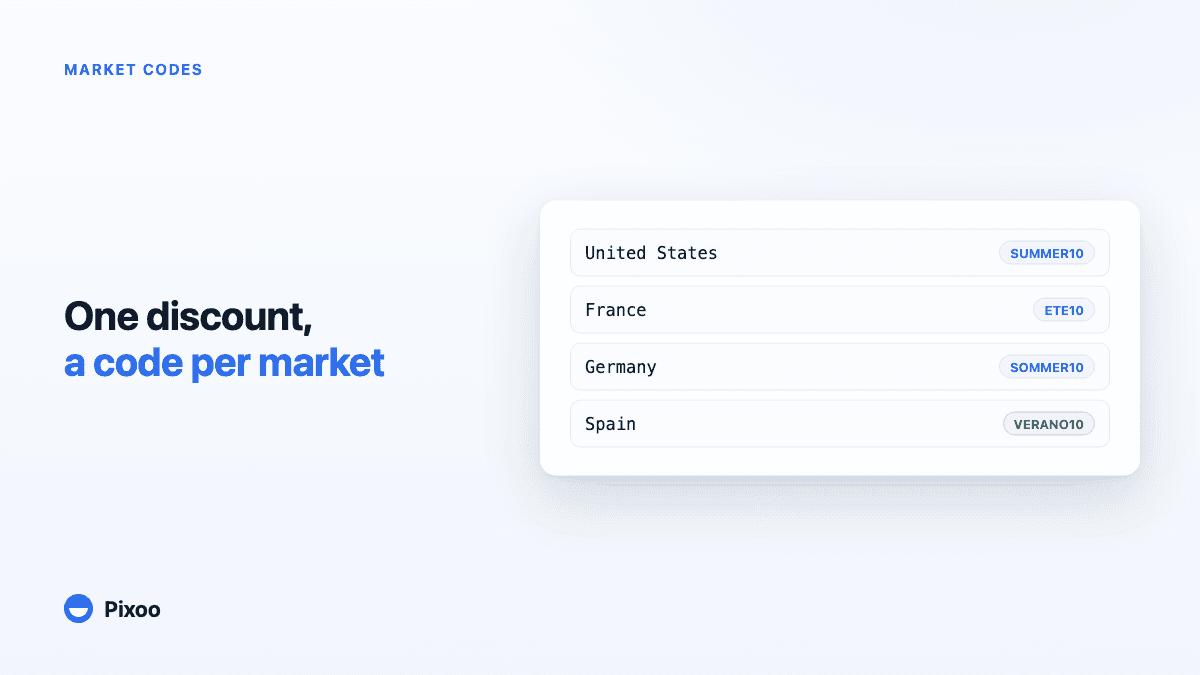
A Different Discount Code for Every Market on Shopify
SUMMER10 reads like nothing to a French customer, and duplicating the discount to get ETE10 means maintaining three of everything. Here is how to run one discount with a different code name in each market, and have each code work only where it belongs.
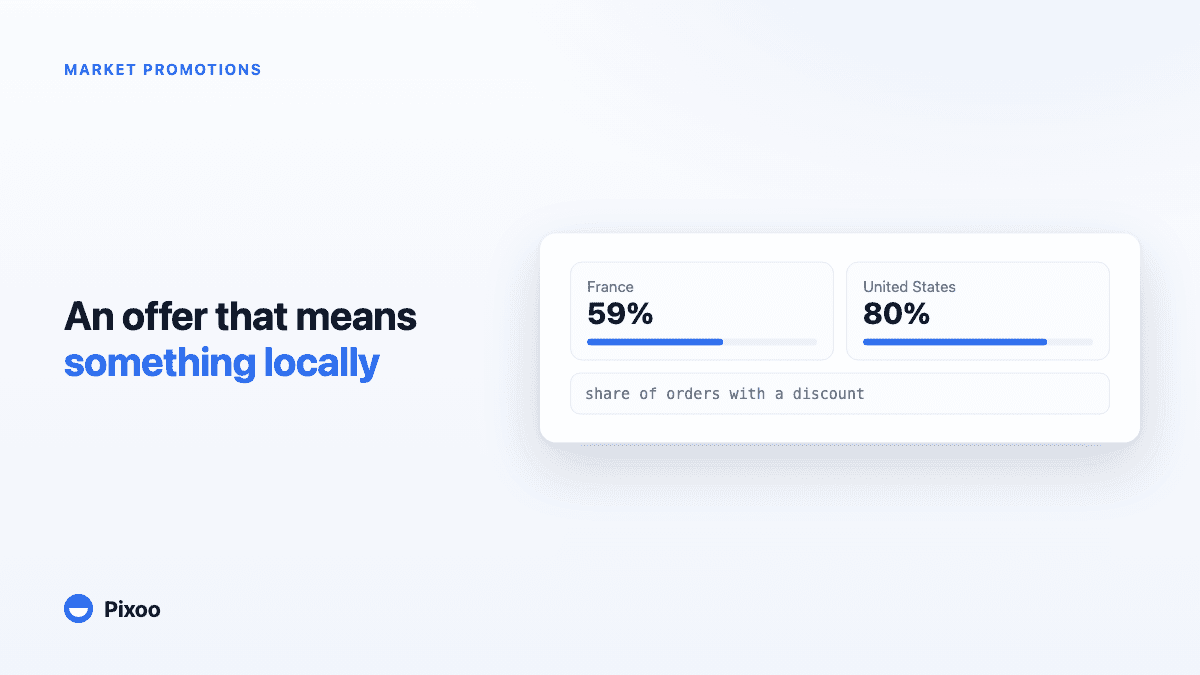
How to Increase International Sales with Market-Specific Promotions
Transform your global revenue with targeted, localised discount strategies that boost conversion rates by 40% and reduce cart abandonment by 58%.